
MA IN GLOBAL GOVERNANCE
Graduate Feature

Spencer Page
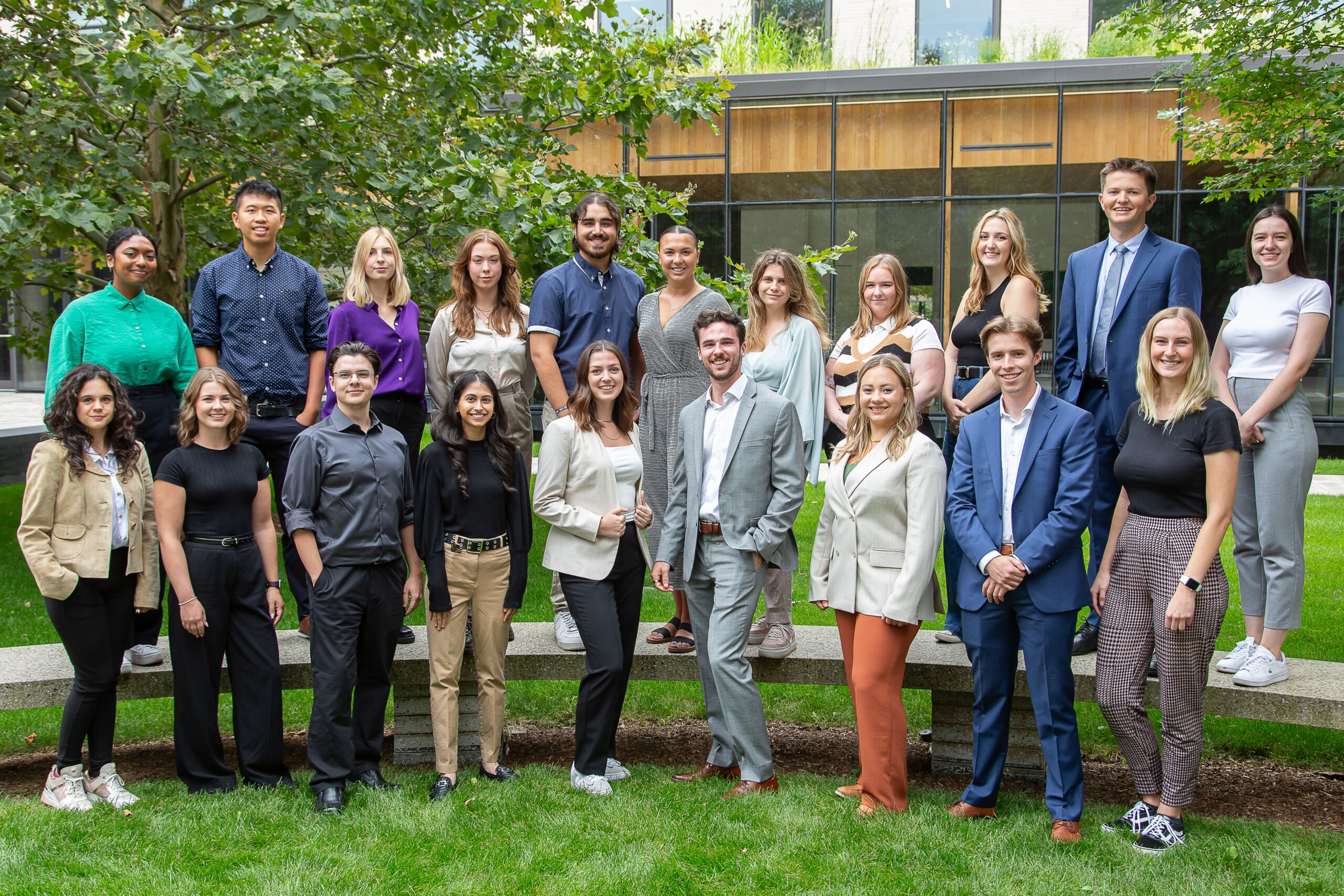
In our first Graduate Feature, we interview Spencer Page, MAGG ‘21, who is currently the Special Advisor to the Assistant Deputy Minister (Policy) at the Department of National Defence. Spencer talks about his job, the skills he attained while a student, and what he liked best about the MAGG program. Read more
University of Waterloo-American University Pathways Program
Established in 2019, the University of Waterloo-American University pathways program is an exceptional educational experience that allows students access to world-class programs and faculty at both institutions. The program allows students to combine the interdisciplinary and experiential approach to the study of Global Governance with additional academic training in applied international affairs through the Master of International Studies-International Studies Track (MIS-IST).
University of Waterloo-University of Warwick Double Degree
Established in 2015, the University of Waterloo-University of Warwick double degree program offers students an opportunity to study in one of the UK’s best politics departments in combination with Canada’s leading school of international affairs. The program allows students to combine the MA Global Governance program with their choice of eleven masters programs offered by the Department of Politics and International Studies (PAIS) at Warwick. Students choose between two routes, either carrying out the first year of their studies at the University of Warwick before proceeding to Waterloo in their second year to complete their degree, or beginning with the first year at Waterloo and then completing the second year at Warwick. At the end of the two years, they receive degrees from both the University of Waterloo and University of Warwick.
Course Requirements
During the first two terms of study in the MA program, students are normally required to take six courses which must include the Globalization and Global Governance (core course), HIST 605 Global Governance in Historical Perspective (history component), or an alternative History course that is related to Global Governance, an economics component, and a political science component as well as two electives. In addition, all students participate in the Program Seminar which meets regularly throughout the first and second terms and includes visiting speakers, guest talks and discussions of the research plans of students for the Major Research Papers. Students wishing to enroll in courses outside of those that are listed by the program are required to provide a copy of the course outline. See full list of courses
Core Course: GGOV 600 Globalization and Global Governance
Economics component: Students may choose one course from a menu of political economy and economics courses. Please note that some courses may not be offered in a given academic year (see 2021-2022 course offerings). Eligible courses include but are not limited to:
GGOV 610/PSCI 688/ PACS 630 Governance of Global Economy
GGOV 611/PSCI 686 Emerging Economies in Global Governance
GGOV 613/PSCI 668 The Politics of National Innovation Systems
GGOV 614/PSCI 614 Global Business and Development
GGOV 615/PSCI 615 Global Poverty
GGOV 618 Special Topics in Global Political Economy
GGOV 619 Readings in Global Political Economy
GGOV 621/PSCI 606/ERS 606 Governing Global Food and Agriculture Systems
GGOV 663/PSCI 619 China and Global Governance
PSCI 683 Topics in International Political Economy
ECON 637 Economic Analysis and Global Governance
ECON 631 International Trade
ECON 635 International Trade and Development
ECON 673 Special Topics in Economics
History component: Students may choose one from a menu of history courses. Please note that some courses may not be offered in a given academic year (see 2021-2022 course offerings). Eligible courses include but are not limited to:
HIST 605 Global Governance in Historical Perspective
HIST 606 International Development in Historical Perspective
HIST 607 Human Rights in Historical Perspective I
HIST 608 Human Rights in Historical Perspective II
HIST 612 Indigenous Rights and Claims: A Global Perspective
HIST 660 Transnational and Global History: Old Problems and New Directions
Political Science component: One of the following courses:
GGOV 610/PSCI 688 (UW) Governance of the Global Economy
GGOV 620/ERS/PSCI 604 (UW) Global Environmental Governance
GGOV 630/PSCI 678 (UW) Security Ontology
GGOV 640/PSCI 658 (UW) Human Rights in a Globalized World
GV 760 (WLU)/GGOV 641 (UW) International Human Rights
GGOV 642/PSCI 639 (UW) Global Social Governance
GGOV 650/PSCI 657 (UW) International Organizations and Global Governance
Elective component: Students must take two additional courses chosen from the list of course offerings; subject to approval from the program directorship, students may also take courses offered by other departments provided the courses contain sufficient Global Governance content.
Examples of electives could include:
GGOV 621/ERS 604/PSCI 604 Governing Global Food and Agriculture Systems (0.50)
GGOV 634/PSCI 620 Gender and Global Politics (0.50)
GGOV 644/SOC 784 International Migration: Practice, Theory & Regulation (0.50)
GGOV 660/SUSM 660 Public International Law (0.50)
GGOV 663/PSCI 619 China and Global Governance (0.50)
New interdisciplinary field in Peace Integration
Students in the MAGG program also have the option of pursuing a Graduate Research Field in Peace Integration. The increasing complexity of global conflict requires sophisticated responses from a new generation of graduates working for peace. The Peace Integration field is a collaborative initiative amongst five masters programs at the University of Waterloo. It goes beyond traditional disciplines that study peace, such as Peace and Conflict Studies and International Relations, by integrating knowledge from complementary programs, specifically global governance, climate change, development practice and health systems.
A Graduate Research Field is a University credential that is recognized on the student’s transcript and is intended to reflect that a student has successfully completed research and a set of courses that together provide an in-depth study in the area of the Graduate Research Field. A student will only obtain the Graduate Research Field on their transcript if they have completed the requirements associated with the MA degree and the requirements associated with the Graduate Research Field.
The course requirements for the Graduate Research Field in Peace Integration are described below.
Students must successfully complete the following courses:
GGOV 600 Global Governance
1 course from the following list:
PACS 601 Systems of Peace, Order, and Good Governance
PACS 602 Practice of Peace
PACS 603 Building Civil Society
PACS 604 Conflict Analysis
PACS 605 Conflict Transformation and Peacebuilding
2 courses from the following list (note: each of the 2 courses must be from a different subject code/area):
INDEV 604/PACS 650 Sustainable Food Systems
INDEV 605/PACS 651 Economics for Sustainable Development
INDEV 608/PACS 652 Water and Security
INDEV 609 Sustainability Concepts, Applications and Key Debates
INDEV 613 Water, Human Security and Development
GEMCC 602 Climate Change: Vulnerability and Adaptation
GEMCC 622 Climate Change, Natural Hazards and Disaster Risk Reduction
GEMCC 640 Climate Change Governance: From Global Treaties to Local Innovation
HLTH 603 Health Systems and Policy
HLTH 604 Health and the Environment (blended on-campus/online offering)
HLTH 607 Social and Cultural Aspects of Public Health (blended on-campus/online offering)
HLTH 614 Foundations of Program Evaluation
HLTH 632 Health Economics and Public Health (online offering)
HLTH 661 Geographic Information Systems and Public Health (online offering)
HLTH 662 Global Health
2 additional courses from the following lists (note: each of the 2 courses must be from a different subject code/area):
History component: 1 of the following courses (or an appropriate alternative):
HIST 605 Global Governance in Historical Perspective
HIST 606 International Development in Historical Perspective
HIST 607 Human Rights in Historical Perspective I
HIST 608 Human Rights in Historical Perspective II
HIST 612 Indigenous Rights and Claims: A Global Perspective
HIST 660 Transnational and Global History: Old Problems and New Directions
Economics component: 1 of the following courses (or an appropriate alternative):
GGOV 610/PSCI688/PACS 630 Governance of Global Economy
GGOV 611/PSCI 686 Emerging Economies in Global Governance
GGOV 613/PSCI 668 The Politics of National Innovation Systems
GGOV 614/PSCI 614 Global Business and Development
GGOV 615/PSCI 615 Global Poverty
GGOV 618 Special Topics in Global Political Economy
GGOV 619 Readings in Global Political Economy
GGOV 621/PSCI 606/ERS606 Governing Global Food and Agriculture Systems
GGOV 663/PSCI 619 China and Global Governance
ECON 631 International Trade
ECON 635 International Trade and Development
ECON 637 Economic Analysis and Global Governance
ECON 673 Special Topics in Economics
Political Science component: 1 of the following courses:
GGOV 610/PSCI 688 Governance of Global Economy (GV 731 at WLU)
GGOV 620/ERS 604/PSCI 604 Advanced Topics in Global Environmental Governance (GV 732 at WLU)
GGOV 621/ERS 606/PSCI 606 Governing Global Food and Agriculture Systems\
GGOV 630/PSCI 678/PACS 634 Security Ontology-Theory (GV 733at WLU)
GGOV 631/PSCI 679/PACS 635 Security Ontology-Issues & Institutions
GGOV 640/PSCI 658/PACS 633 Human Rights in the Globalized World
GGOV 642/PSCI 639 Global Social Governance (GV 735 at WLU)
PSCI 657/GGOV 650 International Organizations and Global Governance
Internship
All students are required to spend the equivalent of one academic term as an intern working on global governance issues in the public or private sector, at a research institute, or for a non-governmental organization. The work-term will normally take place in the third or fourth term of the program.
All students will meet with the Program Manager early in the first term to discuss potential internship options. Students must declare their intentions to the Program Manager by no later than the end of their first semester in the program. A written report (approximately 10 double-space pages in length) arising out of the internship experience will be required and will be evaluated on a pass-fail basis. This report is distinct from the MRP, but can build towards it. For a list of some of the placements that students have done in the past, see Internships.
Program Seminar Component
In addition to their six courses, all students must attend the program seminar. The seminar will meet regularly (sometimes weekly, but usually less often) on Fridays between 12:30-2:00 throughout the first and second terms. Meetings will include visiting speakers (at both the University and at CIGI) and discussions of the research plans of students for the MRP. A preliminary schedule will be distributed at the beginning of each term. Attendance at the Program Seminar is required, but grades will be assigned on a credit/non-credit (or pass/fail) basis.
Master's Research Paper
The MRP provides students with an opportunity to pursue a specific research topic of their choosing relating to the study of global governance. The minimum length is 40 pages double-spaced and the maximum is 60 pages double-spaced (~15,000 words). Students are encouraged to meet informally with faculty members early in their graduate studies to discuss possible topics for their MRP. Students will need to identify their supervisor and second reader on a form they submit in mid-November. Both the supervisor and second reader must be satisfied with the MRP, and either can ask for minor or major corrections or reject the MRP outright. Upon its completion, the MRP is assigned a grade by the supervisor and second reader. To complete by the end of the fourth term, students should normally expect to submit a complete draft by November 1. Students also should normally expect to submit a subsequent final draft for grading by November 30. Note: The supervisor must be a faculty member who is affiliated with the University of Waterloo. The second reader may be a faculty member who is affiliated with the University of Waterloo or with Wilfrid Laurier University.
MAGG Program Handbook and Forms
- MAGG Program Handbook
- MAGG MRP Supervisor Form
- GGOV Reading Course Form
- BSIA Graduate Student Research/Travel Support Application Form
- BSIA Conference Travel Support Application Form
- UW Graduate Studies Research Travel Assistantship Application
- UW Field Work Risk Management Program
- MAGG MRP Template
Learn more
For more information, please contact Andrew Thompson, Program Manager, Master of Arts in Global Governance.